
Field erected tanks are designed to contain substantial volumes of liquid safely for years, but an earthquake introduces forces that are very different from normal operating loads. During a seismic event, the ground moves while the liquid inside a tank responds with its own momentum. The resulting combination of structural movement, hydrodynamic pressure, and shifting loads can place significant stress on the tank walls, connections, anchorage, and supporting structure.
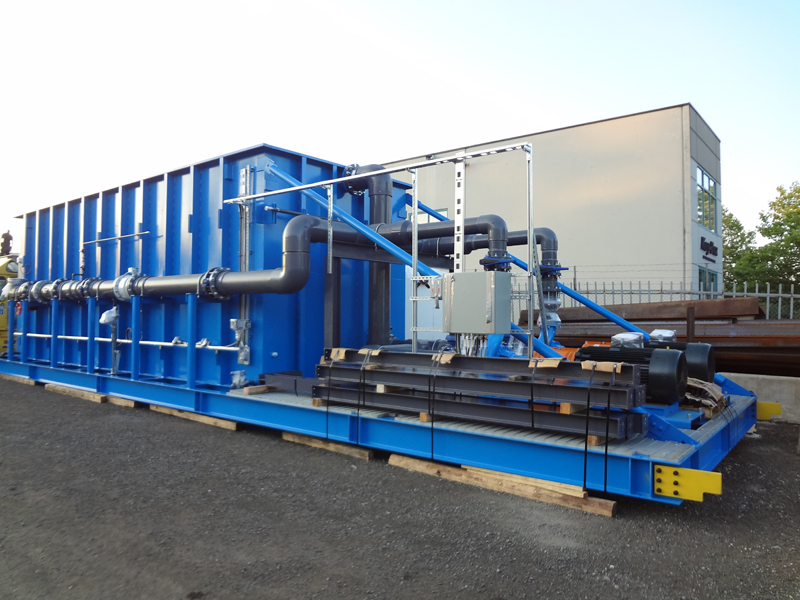
For facilities in seismic regions, seismic tank design needs to be considered from the beginning of a project. Stiffened flat plate tanks present their own engineering challenges because their rectangular walls do not distribute loads the same way cylindrical shells do. Through carefully designed reinforcement, connections, and structural systems, however, it is possible to create earthquake-resistant tanks capable of responding safely to the seismic demands of a given project.
Understanding What Happens to a Tank During an Earthquake
Under normal conditions, the walls of a liquid storage tank primarily resist hydrostatic pressure, which increases with liquid depth. During an earthquake, additional dynamic forces are introduced as the ground and tank structure accelerate.
The liquid inside does not move as one solid mass. Part of it moves with the tank, while the liquid near the surface can develop a sloshing response. These different behaviours create changing pressures against the tank walls and generate forces that must be transferred through the tank structure and into its supports or foundation.
Tank seismic analysis considers these dynamic effects alongside the weight of the tank, its contents, operating level, geometry, material properties, and site-specific seismic conditions. Depending on the installation, engineers may also need to evaluate overturning forces, sliding, anchorage loads, freeboard for liquid movement, and stresses around connections.
This is especially important with custom fabricated rectangular tanks. Large, unsupported flat surfaces can experience considerable deformation under lateral loading. Stiffeners divide those surfaces into smaller structural panels, helping control deflection and distribute forces throughout the tank.
The objective is not simply to make every component heavier. Effective seismic tank design creates a clear and reliable load path. Forces need to move through the plates, stiffeners, connections, base, and supporting structure without creating unacceptable stresses in isolated areas.
How Stiffening Helps Create Earthquake-Resistant Tanks
Plate stiffening allows engineers to increase the rigidity of a flat tank wall without relying entirely on thicker plate. The size, orientation, and spacing of the stiffeners can be designed around the loads the tank is expected to experience.
During seismic loading, stiffeners help wall panels resist deformation and transfer forces to adjoining structural components. Connections between the plates and stiffeners are equally important. A strong stiffener provides little benefit if its connections cannot reliably transfer the loads identified during engineering analysis.
Modern modelling methods give engineers a much clearer understanding of this behaviour. Tank seismic analysis may use detailed structural calculations and, where appropriate, finite element analysis to examine stresses and deformation throughout the tank. These tools allow engineers to investigate how different reinforcement arrangements perform and identify areas where stresses may concentrate.
Anchorage and support conditions also deserve close attention. A tank does not perform independently from the structure beneath it. Seismic forces must eventually be transferred into the supporting structure and foundation, which means tank design needs to be coordinated with the broader structural design of the facility.
Recognized codes and standards can form an important part of the engineering process as well. API 650 tank design, for example, contains seismic provisions for certain welded storage tanks within its scope. However, API 650 should not automatically be applied to every rectangular stiffened flat plate tank. The appropriate codes, standards, and design criteria depend on the tank configuration, application, jurisdiction, and project requirements.
That distinction matters. Good engineering begins by identifying the standards that genuinely apply rather than defaulting to a familiar specification.
Designing for Seismic Safety Without Losing Practicality
A successful seismic design must be safe, but it also needs to be practical to fabricate, install, inspect, and maintain. Adding reinforcement everywhere can increase weight, material costs, welding requirements, and fabrication time without necessarily producing the most efficient solution.
Our approach is to balance structural performance with fabrication experience. Plate thickness, stiffener arrangement, weld details, connections, and support conditions need to function as a complete system. Considering these elements together allows us to develop designs that address seismic demands while remaining practical to manufacture.
This becomes particularly important for critical infrastructure. Water and wastewater facilities, mining platework chutes and bins, industrial plants, and other essential services may need equipment to maintain structural integrity during and after an earthquake. Failure of a storage or process tank can result in more than equipment damage. Depending on its contents and function, it can create environmental, safety, and operational consequences that extend well beyond the tank itself.
There is no universal earthquake-resistant tank design. Seismic requirements vary by location, tank dimensions, stored liquid, supporting structure, and applicable regulations. Site-specific engineering is therefore essential.
With decades of experience designing and fabricating custom shop fabricated process tanks, our team at Dennerik Engineering understands the connection between structural calculations and what ultimately has to be built in the shop. If seismic performance is an important consideration for your next stiffened flat plate tank project, we can work with your engineering and project teams to develop a solution that addresses the applicable loads, standards, and operational requirements.
Frequently Asked Questions About Seismic Tank Design
1. Why are stiffeners important for rectangular tanks in seismic areas?
Stiffeners reinforce large flat wall panels, helping control deformation and distribute loads through the tank structure. Their size and spacing should be determined through engineering analysis based on the tank’s actual loading conditions.
2. What does tank seismic analysis evaluate?
Seismic analysis can consider ground acceleration, liquid movement, hydrodynamic pressures, structural stresses, sliding, overturning, anchorage forces, and other project-specific conditions. The required analysis depends on the tank and applicable design criteria.
3. Can liquid sloshing damage a tank during an earthquake?
Liquid movement can create additional forces and may require adequate freeboard and structural consideration. The potential impact depends on factors such as tank geometry, liquid depth, and the characteristics of the seismic event.
4. Does API 650 apply to every stiffened flat plate tank?
No. API 650 is intended for tanks that fall within its defined scope and should not automatically be assumed to govern every rectangular tank. Engineers need to determine which codes and standards apply to each specific project.
5. Does making the steel thicker automatically make a tank earthquake resistant?
Not necessarily. Plate thickness is only one part of seismic performance. Stiffening, connections, anchorage, support conditions, geometry, and load paths all need to be considered as part of the complete structural system.
6. When should seismic requirements be discussed with the tank designer?
Ideally, they should be identified at the beginning of the design process. Providing site location, operating conditions, tank dimensions, stored liquid information, applicable codes, and structural requirements early allows seismic considerations to be incorporated efficiently rather than added after the design is already underway.