Wastewater treatment facilities are under increasing pressure to process more water, improve effluent quality, and make better use of available space. Expanding a treatment plant by simply building larger tanks is not always practical, particularly when a facility is working within an existing industrial or municipal site. This challenge has encouraged new approaches to settling tank design that can improve separation while reducing the physical footprint of the system.
Technologies such as the advanced settling tank, lamella clarifier, and inclined plate settlers are changing how we think about sedimentation. Rather than relying entirely on large conventional basins, these systems use carefully engineered internal components and flow patterns to separate solids more efficiently. For facilities exploring compact wastewater treatment, high-rate sedimentation can provide an opportunity to increase capacity without requiring a proportional increase in tank size.
How Advanced Settling Tank Technology Improves Separation
The basic principle behind a settling tank has remained largely unchanged. Wastewater enters the tank, flow velocity decreases, and gravity allows suspended solids to settle while clarified water moves onward through the treatment process. The challenge is giving particles enough opportunity to settle without requiring an enormous tank.
An advanced settling tank improves this process by creating more effective settling conditions within a smaller area. One of the best-known examples is the lamella clarifier.
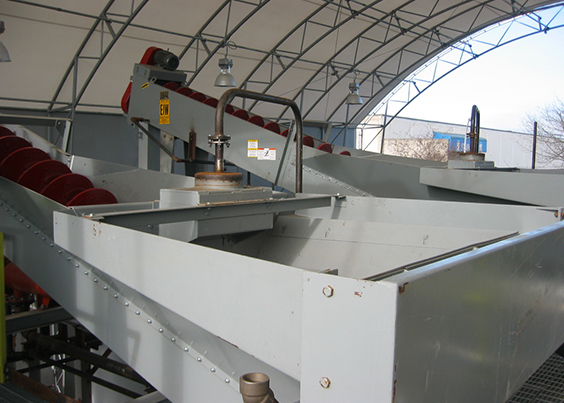
A lamella clarifier contains a series of closely spaced inclined plates. Rather than solids having to travel all the way to the bottom of a deep tank, particles only need to settle onto the nearest plate before sliding down the inclined surface into the sludge collection area.
Inclined plate settlers dramatically increase the effective settling area available within a tank, allowing a much greater volume of water to be treated relative to the tank’s physical footprint.
High-rate sedimentation is particularly valuable when an existing facility needs additional capacity but has limited room for expansion. Rather than constructing a much larger conventional settling basin, an engineered system using inclined plates may provide the required settling capacity within a considerably smaller space.
The benefits are not limited to new construction. Depending on the existing system and treatment requirements, advanced settling technology may also be worth considering when upgrading older facilities.
Designing Compact Wastewater Treatment for Real-World Conditions
While technologies such as inclined plate settlers offer significant advantages, successful performance still depends on good engineering. Simply adding plates to a tank does not automatically create an efficient treatment process. Flow distribution, solids characteristics, sludge removal, tank geometry, and maintenance access all need to work together.
Uniform flow is especially important. If wastewater enters the settling zone unevenly, some sections may become overloaded while others are underused. Excessive turbulence can also keep particles suspended rather than allowing them to settle. A well-designed advanced settling tank manages incoming flow so water moves consistently through the available settling area.
Sludge management also requires careful consideration. As solids collect and move down the plates, they must be removed efficiently from the bottom of the tank. If sludge is allowed to accumulate, it can interfere with treatment performance and increase maintenance requirements.
The characteristics of the wastewater itself also matter. Particle size, solids concentration, temperature, and flow rates can all affect settling behaviour. A design that performs well in one municipal application may not be the right solution for an industrial facility with very different wastewater characteristics.
Material selection is another important consideration. Settling tanks and their internal components operate in continuously wet and potentially corrosive environments. Choosing appropriate materials and protective systems helps maintain structural integrity and reliable performance over the long term.
This is where custom engineering becomes particularly valuable. Rather than treating compact wastewater treatment as an off-the-shelf solution, we can consider how the tank, internal structures, and surrounding process need to function together as one complete system.
Building More Efficient Treatment Systems for the Future
The move toward high-rate sedimentation reflects a broader shift in wastewater treatment. Facilities increasingly need to extract more performance from the space, energy, and infrastructure they already have. Advanced settling technologies can help meet that challenge by increasing treatment capacity while keeping equipment footprints manageable.
There are also practical benefits beyond saving space. More efficient settling can improve downstream treatment performance, while thoughtful tank design can simplify sludge handling and routine maintenance. For existing facilities, compact systems may also provide greater flexibility when planning future upgrades.
That does not mean conventional settling tanks are becoming obsolete. Every project has different flow conditions, treatment goals, site restrictions, and budgets. In some situations, a traditional clarifier remains the most practical choice. In others, a lamella clarifier or another advanced settling tank design can offer clear advantages.
With decades of experience designing and fabricating custom process tanks, we understand how important it is to match the tank to the actual application. If you are considering a new wastewater treatment system or looking for ways to increase capacity within an existing facility, our team at Dennerik Engineering can help explore tank designs that balance treatment performance, available space, durability, and long-term operating needs.
Frequently Asked Questions About Advanced Settling Tanks
1. What is an advanced settling tank?
An advanced settling tank uses improved internal design, flow control, or settling technology to increase the efficiency of solid-liquid separation. Depending on the application, this may include inclined plates or other features that increase the effective settling area.
2. What is a lamella clarifier?
A lamella clarifier is a settling system containing multiple inclined plates. Suspended solids settle onto these plates and slide downward for collection, allowing a large effective settling area to be created within a relatively compact tank.
3. How do inclined plate settlers reduce the size of a settling tank?
Inclined plate settlers shorten the distance particles need to travel before reaching a settling surface. By arranging many plates within the tank, engineers can provide substantially more effective settling area without requiring the same floor space as a conventional basin.
4. What is high-rate sedimentation?
High-rate sedimentation refers to processes designed to achieve greater settling capacity within a smaller footprint than traditional sedimentation systems. The exact design depends on wastewater characteristics, required flow rates, and treatment objectives.
5. Can advanced settling technology be used to upgrade an existing wastewater treatment plant?
In some applications, yes. Compact settling technologies may be considered when a facility needs additional treatment capacity but has limited space. The existing tanks, hydraulic conditions, wastewater characteristics, and structural requirements should all be evaluated before selecting an upgrade approach.
6. Are lamella clarifiers suitable for every wastewater treatment application?
No single settling technology is ideal for every facility. Solids characteristics, flow rates, sludge behaviour, maintenance requirements, and treatment goals all affect optimal system selection. An engineering assessment can determine whether a lamella clarifier, conventional settling tank, or another solution is the best fit.